Permaculture Design Course Handbook

Tag: food forest

  • 2020 Food Forestry Recap through Designs

    2020 Food Forestry Recap through Designs

    As I reflect upon this last year of tree planting through the design documentation that I love to do on these days that are cold and day length is short, I remember what was and what is.  My yearning to plant trees is still strong, mostly limited by resources like time and money.  Nonetheless, the desire to create pockets of biodiversity here at Treasure Lake is still there, scaled to fit these resource limitations and abundance in other ways. It has become quite obvious to me the speed and scale to take to ensure the trees that get planted this year will be able to be taken care of next year as well. That compounds over time as the yearly spring and fall plantings begin to add up over a 4 year period. Moreover on the pattern level, the where and how (earthworks) to plant just pops out in my daily walks and travels around the farm.  Here on my families land I mainly work the edges through the develop nuclei and let them merge over time pattern of small scale intensive. Furthermore, my time constraints often come from caring for animals, which their manures from their housing is being directed partly to tree crops and plantings through deep mulching.  Areas that I want to do broad acre tree crop plantings through alley cropping are now getting animal rotations thus helping to improve the soil before we ever make that intervention. 

    Treasure Lake Food Forestry

    Here on a 60 acre property, it is hard to not say that nearly all of it is actually a food forest.  The amount of foraged foods harvested this year probably outweighs my cultivated gardens and trees. But the cultivated stuff is young, there was a late frost, and the semi cultivation of the forest for over 20 years now does make it an easier statement and easier harvests. Nonetheless each year we build off of existing edges and existing plantings while building out new spaces.  For example the back hedgerow got a little longer and thicker and a new banks development was created thus extending that edge. So each year that we are here, we will continue to manage what is here, plant more, and envision what is next.  I try and operate with the mantra of don’t start planting until most of the stuff you planted before is well taken care of. Sometimes you do it concurrently because of the weather and spaces. Furthermore, I have lost too much stuff in the past to not take care of stuff properly, especially when I do have a mountain of woodchips and now heaps of manures. 

    Nursery

    The expansion of the Growing Value Nursery here at Treasure Lake was enough for a whole years worth of writing and work.  Nonetheless it is just one part of the bigger story.  This year really marked a significant growth of the size and offerings of the nursery. The size here at Treasure Lake tripled, we implemented a new urban site in Pricehill in Cincinnati, and the organization of the nursery was upgraded.  Each year I have been back I have taken one step further into the organization and day to day operations, especially in the very busy and demanding spring. From a design perspective, with the tripling of size, it is the four very large sugar maples that really make this all possible.  Of course the water infrastructure as well as access and the building headquarters being right there is critical as well. The design drawings show this below as well as the 7000 sq foot area taken up by plants. 

    Edible Landscaping at the Tiny House

    This is one of those examples of you set up the framework in the fall (19) and then you plant out further in the spring (20). So after sheet mulching beds and planting paw paw and strawberry at 15 ft spacing, this spring was time to add in different layers with bushes in between. As you can see below we used currants, gooseberries, bush cherry, and honeyberry mainly. Beyond that, a greywater/ rain garden system was implemented and combined well together with pipes from both going to the same earthwork.  Remember from a design perspective, both are holes in the ground with mulch and plants on the simplistic pattern level. Additionally after living in a zone 0 for a bit of time, some of those classic herb/ flower beds sprout around the house as well a veg garden.  Being in sandy soils and knowing that it would mainly be a summer garden, we went with the sunken bed strategy that I loved in my time in the Iberian drylands (2009- 2016).

    Swale

    Swale implementations are based upon seeing runoff that can be infiltrated rather than running off.  We did exactly that with the winter weekend PDC of early 2020.  In this area where our unique sandy soils switch to the normal heavy clays, we indeed hit pockets of each as we dug this swale.  We did combine elements of both swale and terrace as we reinforced the backside of the swale mound with logs as you would a terrace.  Furthermore being varying degrees of shade, we added in what we could on the low budget and plan to plant more Euro Pears in this area.  Its another phase in this area just to the north of the paw paw orchard that is also being currently upgraded.  


    Another Hedgerow/ The Chicken Yard

    The same property line as the hedgerow that I have been developing for years now is being furthered extended east. I have big plans of filling in with more evergreens to compliment the existing large white pines, but for now taking advantage of a great little microclimate. About 10 years ago, when I was in full swing of my travels, I put in a handful of nut trees on this back edge.  Only one survived that being a northern hardy pecan seedling so I planted two grafted ones on its flanks to compliment.  The intended design for this area is to beef up the evergreen windbreak and fill in on the south with tree crops.  This pattern will extend to the southern border of the chicken/goat yard as we need more shade in this area come summer time.  To make it more hospitable, well I did what Uncle Bill told me to do; Plant Mulberries in your chicken yard.  Those drawings in the Intro to Permaculture book still are burned in my head of the chicken yard.  


    The Back Hedgerow

    This being my oldest planting of any real size and success (fall 2017 start), this section continues to fill in and grow well.  The nuclei are ready to merge even more this year as my 6 ft diameter beds have grown to be more like 8 to 10 ft diameter as the woodchip mulch is extended outwardly and thickened each year.  A lot of energy goes into this 250 ft long hedge each year so I decided to augment some things this fall.  With some of the blueberries simply never performing, even after replacing a few of them, I planted other stuff right next to them.  I figured why even bother pulling it out and lets take advantage of these circular growing spaces that have been mulched and fertilized for years.  So five of those circles were augmented. The first was to add a Kousa dogwood right next to one that has been growing quite well since that fall 2017 inception.  Next to that two cornelian cherry as they are in the same family.  In front of that line, a couple of the circles got the Asian Pear Olympic variety.  That felt good to make that switch and know these trees will instantly thrive because the soil has been building for years.  As I did this I thought why not more Asian Pears and on my walks of checking on these new plantings over the next weeks I let two more spots for Asian Pears reveal themselves, partly from looking at the maps seen below and partly form on site observation.  So we thickened the back hedgerow on the far west side with two more Asian Pears from the nursery that were looking very ready for a soil home.  Kosui and Shinseiki bring our total of Asian Pears on the property up to 10 with six different cultivars.  I look forward to collecting more cultivars.  And with the 2021 season ahead, unless we get a late frost again like 2020, we should be starting to see some fruit production from plums and pears as the grafted trees coming into fruit age is upon us.


    The New Banks Development

    With a permablitz badly needed for the community and the site, we brought a good sized group of 40 or so together one mid November for some cool bee hive like motion. It actually went very smoothly as we did lots of staging work beforehand that allowed people to start finding their roles and begin implementing.  So the hazelnuts and paw paws and elderberries were dropped in on the eastside through individual tree planting terraces.  Also the native buttonbush shrub was added lakeside to bring back lake edge pollinator habitat in the coves of the lake.  Above that terraces of apples and elderberry were added to further our banks development mission that we started last year.  This year it was the apples turn to be the star of the show and this time within a valley rather than the faces of the ridges.  The apples were a mix of tightly packed dwarves and semi dwarf trees flanking on the edges where there was more space.  Two dolgo crabapples were added to ensure pollination and to compliment two mature redbuds already there growing.  In this way we bring that botanical forest mission further, to utilize our already existing trees as framework for these sorts of plantings rather than simply clear cutting for a blank slate.  I really look forward to caring for this particular planting because so many of the other plantings are slightly out of the way of the zone 1

    Back hedgerow Asian Pear addition

    path that extends a quarter mile from the tiny house to the big house, both zone 0’s here at Treasure Lake.  So daily I get to observe this new planting numerous times a day and am super thankful for all who came and planted! 

    I really enjoy being able to setup these spaces and do the work of building soil rather than weeding lots.  That means deep mulching and at the end of the day I kid with so many I teach that Permaculture is just moving organic matter from one place to another.  And that folks is why we do design work.  Start designing for spring plantings.  And once more thank you for all the helping hands who contributed to tree planting, mulching, fencing, and general care for this place.  

    Treasure Lake, January 2021
  • Tree Planting Recap 2019

    Tree Planting Recap 2019

    Lets face it, I love planting trees. Doug the Digger. And after moving back to Treasure Lake in Northern Kentucky in summer of 2017, I have been busy planting and caring for trees. However in 2019, it took a large step forward building on top of what was before and planting in new spaces framed by a new zone zero; the tiny house. And this planting extends beyond just Treasure Lake, both in Petersburg, KY as a part of community building through my tips for tree planting jar, and also urban permaculture in Cincinnati. And yes I have been planting Paw Paws, and you can to with confidence after taking this new course, Paw Paw Master Class. Below is a list of locations and descriptions along with design visuals, videos, and pictures.

    Treasure Lake: Petersburg, KY

    Back Hedgerow/ Backstop

    What was my first planting in fall of 2017, the back hedgerow, was dialed in a bit further this spring as previously planted nuclei have progressed nicely. First, I had to replant a few blueberries, which were knocked back aggressively by rabbits and were weak plants to begin with. My tomato cages work for deer for the most part but not for rabbits for sure. Properly caging everything throughout all these plantings has been a goal of mine this year and fully achieved. From there, I expanded in both east and west directions. The Methley plums on the east side have been growing quite rapidly so I decided to add in a couple of Asian Plum (shiro) to compliment. And being in love with Nashi fruit, Asian Pear, I added two of these beautiful trees to compliment the European Pears also in the hedgerow. I definitely dialed back the guilds for these new trees and went with a stronger sheet mulch because the weeds are quite intense and overbearing if you don’t do this heavy sheet mulch from the beginning. I also added in numerous berry plants within the guilds of the older plantings including six chokeberry seedlings and two white currant imperials. (Spring planting)

    Furthermore just a small distance away from the two Asian Plums on the east side is a backstop that my grandfather had built many years ago as part of his dream to have a ball field at the lake. After years of junk collecting there and then it being finally thrown away this spring, it opened up a great edge for planting on this vertical resource. It is slightly U shaped allowing for five vines with two different species used. One of them is Hardy Kiwi so one male for pollination, one Ana, and one Michigan State. The other is Akebia, or Chocolate Vine, with one variety being Shiro bana and the other being silver bells. The hardy Kiwi, like expected, grew slowly yet the Akebia grew at a ridiculous speed with over twenty feet of growth in one year, a drought year at that. (Spring planting)

    Backstop with coppice sycamore in front, vines planted at base of fence

    Western Hedgerow Mushroom Bed

    permaculture design western hedgerow treasure lake

    This triangular hedgerow is composed of wine cap mushrooms beds underneath a food forest style planting. Both performed very well along with abundant harvests of mushrooms. The mycelium breaking down the wood chips not only provided buckets of delectable mushrooms, it also seemed to unlock fertility. Thus I added in a couple more jostaberries, gooseberries, currants, and chokeberries to round of this space. The main anchor species of quince are growing very rapidly and I look forward to that fruit.

    Bar/ Community Center

    Out in front of the bar/ community center/ classroom I planted in two new trees to replace the old big box elders that once casted shade on the bar during our intense summers. They died out as my grandparents passed and I planted these two new trees with being an homage to them. The choice was Rowan or Mt. Ash, which are known in antiquity as gatekeeper trees that keep bad spirits away. And they are beautiful and do produce an edible berry with this cultivar of Rabina. I had seen these trees line the streets of Eastern European towns i once walked. I also added some more edible landscaping plants in the bar landscaping beds like Jostaberry and Pink Currant. Honestly I just want to use them for propagation in the future, a different yield than just berries. I also fully dialed in the permanent location of the nursery under two large sugar maple trees for both Cincinnati Permaculture Institutes Growing Value nursery and my own personal nursery. The big addition in my own nursery was the scaling up of paw paw production with enormous success. This allowed for planting at treasure lake and beyond and is one of the topics we cover in the Paw Paw Master Class (Spring planting)

    2/ 25

    Campsite 3.5

    Over the years I numbered the campsites 1-5 but through use of a machine and general edge development, more campsites were developed. I never renumbered them, just added .5’s to help keep the continuity of name and place going. This particular space is a place that has been being developed for quite some years now with grafted paw paw complimenting the huge paw paw patch already there (planted in winter 2016). Thus in the spring with both the year-long PDC from the Cincinnati Permaculture Institute and me and Abby’s Spring class, we planted in lots more. With the PDC we planted terrace edges complimenting the chestnuts planted the fall before with Tom. This planting pattern was black capped raspberry and serviceberry flanking the chestnuts. Then with the other class we did a corridor planting with a mix of elderberry and hazelnut along the dry streamed. Even with the drought and no rain almost everything survived. I did a demonstration planting first with a beautiful Russian Hawthorn going in. Furthermore, in the fall we planted one more tree with Allison, a contributor to the place in so many ways. She donated back by purchasing a tree after her Into the Deep Soul event at the lake and her further connection to this place was solidified with a tree planting. On one of her volunteer days, I earlier in the day had been at Braden Trauth’s house, the director of the Cincinnati Permaculture Institute, and he had given me a Jujube of Chinese date fruit from his front yard tree. I gave it to Allison and she loved it! We decided to replace a Jujube that had died out in this area. There was still one alive in this area that was planted years ago when the grafted Paw Paws were planted. Thus we dropped a Black Sea Jujube in and hopefully the pollination is there for the two to thrive in this outer zone area.

    25

    Tinystead Development: A New Zone 0

    Having never really felt settled here from not having a true living space, when the tiny house was lined up for arrival it immediately gave me a spark to plant. In the spring before the tiny house even arrived, myself and Carolien planted hazelnuts to the west on a slope to a cove before campsite one where the tiny house is located. Five were dropped in and the plants came from neighbor Daniel and more on that later. We also planted three Catalpas in the valley behind that cove together in that fun late spring. In late summer Carolien and I planted more after the first rain we had in quite sometime thinking the rains were finally coming back. We dropped in 12 Paw Paw together after a chop and drop in a zone directly behind the tiny house along the driveway.


    I planted the final three with Griffin, an intern from University of Cincinnati, who has really stepped up and is learning a lot through our hands on work and talks. Then between myself, Griffin, and Allison we took a step further once fall had kicked in with planting the rim of the ridge plateau that the tiny house sites on. We planted in more of my homegrown paw paws raised from seed earlier this year. From there we headed downward to develop what I call the Banks development, which are the mainly south facing slopes below campsite one and two. First was hazelnut on individual tree planting terraces spread amongst regenerating oaks, redbuds, and black locust. The slopes of these banks, mainly to the north are towering shummard oaks, burr oak, and sugar maple. Thus it is always a balance challenge to find what will work best with the shade and what trees need to come out overtime.

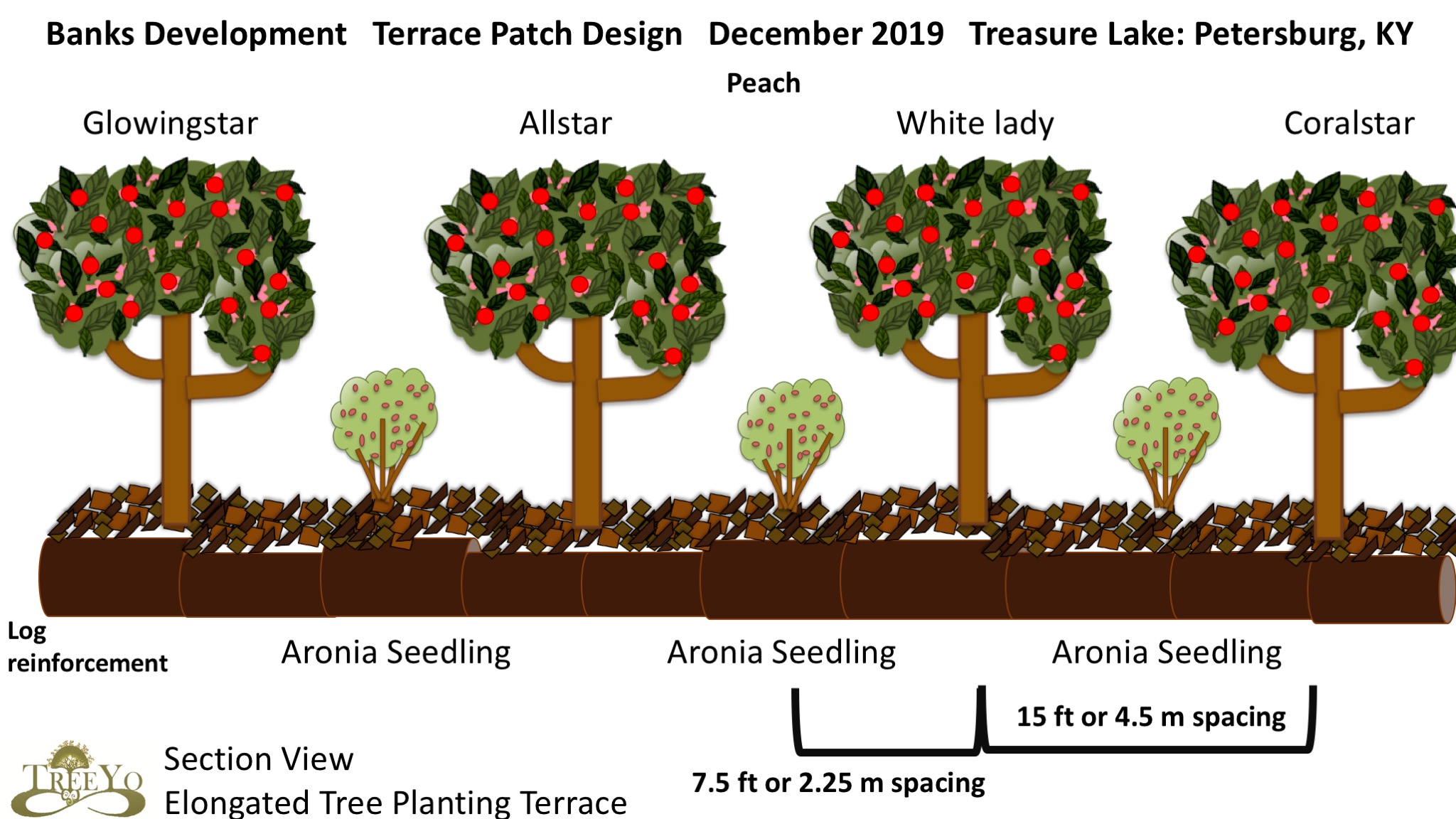
    From there we moved onto the nectarines and blackberry to the west with two of the nectarines going on a terrace that further framed the pattern development for more of the banks. The blackberries were self propagated while many of these trees I am mentioning came from The Cincinnati Permaculture Institute’s Growing Value Nursery which is partially housed here at the lake. Above the nectarines down the main path path two Carolina All Spice trees were added to be entry trees. Further above the nectarines to the west deeper in shade we added witch hazel and vernal witch hazel to diversify the native palette. From there we moved eastward with other friends like Robert and Rachel helping with more individual tree planting terraces. To compliment the non native Eleagnus, we planted in the cultivar of Goumi. To compliment an already existing mulberry we put in another homegrown one as well. And we got a couple of Elderberries in the valley in between camp 1 and 2 below the 15 paw paws planted in fall of 2017 in that same valley. On the path we added a couple more russian hawthorns to the first one we planted in spring with Matt Gillespie, my paw paw class partner. From there we moved to the banks of campsite 2 and added in were 4 chestnuts procured through a trade with my friends Michael and Joanna down in Berea, KY but a Portugal connection. They got some of my paw paw, I got some their chestnuts. From there we knew we needed help and had our pattern well enough dialed in to invite others to come in and support and learn from our pattern. Thus we planned a permaculture action day of terracing and planting and over twenty people stopped through with over 150 ft of terrace dug in difficult conditions. All in all we planted 3 Jujube on elongated terraces and one on its on own in the furthest west part of the banks development. It is a rough and tumbled point showing to plant something hardy with the spiny vegetation that persists already. And west of that added was a very long asian pear terrace that four different cultivars fit on quite well. Above that I was going to do a fifth but as we were chopping and dropping scrub vegetation I found a hawthorn and decided to add in another Russian hawthorn there to compliment. That action day was great and yes a lot of work was done physically but also community formed. From there we made one big push as tree planting season was ending. The push was to get in the peach trees, an homage to my moms father who had some great peaches his suburban edible landscaping in Cincinnati. My mom wanted to plant this memorial garden and we again moved large logs for terraces, did terrace sculpting of the land, painted the landscape with four different cultivars of peaches, and interplanted with chokeberry. We sheet mulched heavily with cardboard and two loads of wood chips of my van with some friends helping to make the final push of the mulching. All along the way we added compost to the trees, home grown in my worm bins, and made cages to protect as the wildlife pressure is just two intense to not to. And as we sat on those banks with the fading sun, we realized the place had changed forever, in a very dynamic and positive way.

    Much of the planting was supported by the tips for tree planting jar and private donations. The other was Alan Wight’s Giving Tree Foundation. It gave us much needed extra capital for filling out our educational plantings. I am deeply appreciative of that and all who gave time and money to make this grand implementation happen.

    Daniel and Colleens Half Acre Homestead: Petersburg, KY

    I am blessed to have neighbors less than a half mile away that are into permaculture, community, and homestead lifestyle. I have watched their yard develop nicely and produce food abundantly as I drive in and out of the lake. This year I decided to donate and trade plants with Daniel along the way to help fill out our food forests. The donations were done by the community through our tips for tree planting jar, which generated thousands of dollars worth of donations this year. From our bar business, camping, and fishing, the money was all donations to this fund. Daniel and Colleen’s yard got lots of the berry layer of the food forest this spring, currants, gooseberry, honey berry, serviceberry,raspberry, blackberry, siberian pea shrub, and some natives like witch hazel and sweetshrub. While I didn’t do the direct planting, I helped do the layout with Daniel. It is a fun yard to watch develop with their limited input but quite amazing outputs.

    Josh and Maddy’s Homestead: Petersburg, KY

    Daniels brother Josh and his partner Maddy own a larger piece of land a few miles down the road and are also into permaculture, community, and homestead lifestyle. Thus I supported them with the tips for tree planting fund and trades and also got to help on one of their tree planting days. We tried to run an action day there as well but the rain came in a way it hadn’t done so for literally months. Nonetheless the space in front of their home was changed forever with a large implementation of food forest planting extending off their already existing plantings. With chickens in the foreground and goats in the background this site has amazing potential and just took big next steps. Josh does really great fish scale tree planting earthworks for each tree because his soils are quite heavy. The uphill sunken boomerang will infiltrate water while the raised platform of the tree will give some extra root space before it hits the quite compacted and heavy clays below. The site got quite a diversity of plants with not only the berry layer, similar to Daniels list but also lots of fruit trees like asian pear, medlar, peach, nectarine, apple, and cornelian cherry.

    Lincoln Heights: Cincinnati, OH

    I was drawn into this garden through the Cincinnati Permaculture Institute this spring to help advance this urban Permaculture initiative in Lincoln Heights. The neighborhood was started as an african american initiative and continues to be that way. Thus on this vacant lot, gardens were created and fruit trees planted in 2018. In 2019 the place was overgrown with weeds and not much happening, a common symptom of community gardens. So I came in and started taming the jungle and doing deep sheet mulching for the existing trees. This helped to setup the fall planting which focused on replacing a few dead anchor trees, adding the berry layer within the tree rows, and flanking with the shrub layer. The new anchors became plums, Methley and Shiro, and a Dolgo crabapple to be a universal pollinator for the apples since some of the trees that died out were apples. And the berries were jostaberry, currants, gooseberry, and chokeberry. On the flanks were my homegrown paw paws and also elderberries from the nursery. I donated the paw paws from my tips for tree planting fund and the rest of the funding came from Alan Wights giving tree foundation. It was tough digging, through rubble of all sorts, but man is there some good top soil. Myself and Griffin dig extra digging and breaking up the hardpan below because the heavy clay below seemed to be the culprit in the die of the other trees. We will mulch heavily when our next round of woodchips get delivered but for now they are in the ground.

    Permaculture Action Network Day: Berea, KY: Clear Creek Community Food Forest

    In the sweltering heat of mid summer, my Berea crew, who are connected to me through Portugal invited me to facilitate a tree planting action day based off of all their handwork in the community and beyond with their work with the Permaculture Action Network (PAN). They are chapter leaders, Joanna and Michael, and fate found them land only two hours to the south of Treasure Lake way before I ever made it back here in 2017. Its such a blessing to have this refuge but on this day it was hard work but some serious action happened. We chopped, we dropped, we dug, we planted, and we learned as there was the action site and the learning site. Fabulous was it!

    Conclusion

    So the hashtag of #letsplantsometreesyo was definitely enacted in this wonderful year of growth and further rooting. You can always plant more but what Permaculture teaches and what I have learned overtime again and again is that small scale intensive principle. This is why I write this blog, to encourage you to take next steps, have a goal of two to 10 tree crops a year and simply take care of them well. Do the extra work at the beginning to set them up for future success and less maintenance on your part. See when you deliver an action to the landscape like planting, there will be an equal and opposite reaction of maintenance. This forces us to go slowly, develop nuclei, and let them merge over time into a well developed food forest! Growing food, infiltrating water, building soil, promoting biodiversity, these are the solutions of climate change and healthy living. Do your part people and if you cant physically, well support others with your excess resources of time or money, please. Give back and the energy will cycle.

    Written by Doug Crouch

  • Terra Alta Food Forest Update: A Vlog from my old home: Sintra, Portugal

    Terra Alta Food Forest Update: A Vlog from my old home: Sintra, Portugal


    It was a true joy to see it again. Years and years of effort to rehabilitate what once was just an abandoned track of land.  The stacking in space and time, the building of resources to enhance succession, the diversity, it is all there on this special slice of land at Terra Alta, Sintra, Portugal.  Its former state was simply being completely covered by blackberries with few trees on it.  Now its a thriving jungle of food that has produced a lot over the years and now as the trees mature, its more the fruits that are the reward.


    I stewarded this space from 2012 to 2016 and was the main architect of its development.  I worked hand in hand with Pedro, the founder of the project, and many a volunteers and students and other permaculture professionals along the way.  It is a joy to come back to such a spot.  Now the need for soil building operations has lessened and less maintenance needs other than pruning. However Pedro and his cohorts continue to develop it and enhance its beauty and functionality!

    read more on food forests:

    Food Forests or Forest Gardens