
Written by Doug Crouch
Holistic Analysis
Having installed several rain gardens large and small and also having been present when they got really popular in the states, these are simple design features which preform many functions. And I can’t bring you any further in a description of this design element until Uncle Bill and his great quote is heard which exemplify rain gardens,
“Though the problems of the world are increasingly complex, the solutions remain embarrassingly simple.”
We have crumbling infrastructure in cities, flood and drought syndrome costs are far reaching and expanding deeper into the social realm, water quality degradation rages on,  and water shortages are becoming commonplace in headlines. These are increasingly complex problems that are usually followed with high energy (high monetary investment) solutions which merely bandaid the problem. Storm water runoff surges damage municipal pipe infrastructure. Meanwhile because the storm pipes are most commonly combined with sewage pipes, raw sewage bypasses treatment plants in times of heavy rain causing water quality challenges. This problem/opportunity must be examined systematically and holistically rather than materialistically and rationally as done currently by governments and developers. In other words, where are the leverage points, where is the point source, and how can it be managed to be seen as a resource instead of an extra cost? A good framework might be to answer the following questions:
- How does the rainwater off roofs help to grow food locally and abundantly?
- How does it support native species and biodiversity?
- How can we examine the “phrase from roof to river” to maximize the resource and give back at the same time?
- What costs are associated with floods, droughts, and combined piping in municipalities?
Our ethics in permaculture look for integrated, simple solutions and the principles lead us to the design for interconnectedness.

The General Pattern
The phrase roof to river is indeed a great lead into justify why to install rain gardens. Roofs or roads, sidewalks and parking lots, compacted lawns and patios being the headwaters and a base point for the observation and assessment part of the design process. The source we examine is a surface that is referred to as impervious and sheds water at different flow rates. The assessment phase of the design process can be aided by our page on catchment calculations as it details flow rates and aids in calculations pertaining to how to size the earthwork appropriately in relation to the catchment area. Most often with rain gardens the surface that feeds the earthwork is a roof and is accompanied by gutters and piping. These facilitate distribution to certain points and when possible it should be directed into a water harvesting earthwork instead of a sewer system or carelessly cascading through the landscape. Furthermore, the rain garden itself in its easiest definition is the following, “well, it’s a hole in the ground with some mulch and some flood and drought hardy plants.”

When presenting this topic in a weekend PDC in Cincinnati, Ohio, USA in 2011, I was asked where in nature this occurs since I was speaking about how we get inspiration from nature. The next day I went for a hike and found the inspiration before me. It was a fallen tree, very recent, that had lifted its root ball which had quickly accumulated organic material and rainwater. The picture below is from this event and I of course documented it and reported back to the student the next week my observation.
 By comprehending and copying, as Viktor Schauberger would say, ecosystem services are accomplished with little input. So in the context of a rain garden the water is directed towards a basin that is sized to the roof catchment area and abundant rainfall amounts. Volume holding capacity of the earthwork should correspond to volumes of water being shed by the impervious surface under high or regular rainfall amounts. You can always over or under size but the plantings may suffer and a planned overflow is always necessary. Earthworks should be located 15 ft (4 meters) away from the house to protect foundations. Remember rain gardens, like swales, are meant to infiltrate not store water so they are uncompacted and should drain within 24 hours.
The process:
The size, shape and volume of the basin vary but rain gardens are generally located on slopes that are very gentle or flat. Swales essentially are rain gardens elongated but done

on slightly steeper slopes. Terraces are implemented on the next degree of steepness. All facilitate infiltration and completion of the hydrological cycle. When on a slight slope the earthwork has a terracing affect so that volume of water can be achieved. Basically it is a round, or oval shape, or even butterfly shape to increase edge and access. Tools that aid are shovels, picks, water levels, and wheel barrows. Machines can be used for the excavation part and in Iowa, USA in heavy clay soils a subsoil ripper is used in larger rain gardens for commercial sized roofs. Sand was also integrated in these heavy clay situations to increase the earthworks infiltration rate. Addition of organic matter (compost) also helps to increase the infiltration rate and capacity to retain moisture for the associated plantings. The basin itself can be coated with compost to help repair the disturbed soil food web from the digging. Meanwhile the basin is filled with organic material like wood chips or other woody or carbonaceous debris after the basic plantings happen. Plantings on the rim of the basin are also composted and mulched and the rain garden should be designed for access and how it interrelates with other elements in the system.
As the soils and plantings mature, the infiltration rate increases although earthworks do also tend to silt up overtime thus reducing the volume they can handle. The plantings that  happen in the basin are plants that can handle continual inundation but also periods of dry. In more humid, temperate climates these are usually prairie plants and nurseries can outfit you with those. These prairie plants can be part of your integrated pest management strategy. In temperate regions the rim plantings are often food producers with a focus on natives. In my home region of Ohio, USA plants I suggest on the rim include Chokeberry (Aronia melancarpa), elderberry (Sambucus canadensis), currants (Ribes sp.) and Paw Paw (Asimina triloba). All are natives and can be a part of a more extensive food forest. Guilds can be established on the rim with supportive plantings of comfrey, yarrow, goat’s rue, and french sorrel.

Project Example:
The pictures below are from a project implementation of rain gardens that are fed by a nearby roof to create zones of humidity in an emerging food forest that I led in early 2013. In this subtropical Dominican Republic mountain zone of Jarabacoa, these  earthworks ensure detrimental runoff doesn’t happen from the impervious surface. Instead it supports part of the edible landscaping portion of a farm-to-table project. They were dug with machines and we used a bunyip or water level to ensure the bottoms were level which was aided by hand digging. The rims were mulched heavily and planted mainly with Platano’s, a starchy staple similar to banana that the restaurant used heavily. In between the basins were other food forest plantings and of course the associated support species including nitrogen fixers. The basins were similar to banana circles which have been known to be used as greywater pits and/ or rain gardens in the tropical context.


Large Scale – Infiltration pits
On larger scales, these rain gardens are called infiltration pits or bio-swales. And if you dig a pond and it receives runoff but the pond is not sealed, it becomes a rain garden. Giving water a place to infiltrate and interact with carbon and a microorganism filter is extremely important for ensuring that groundwater supplies are kept plentiful and clean.


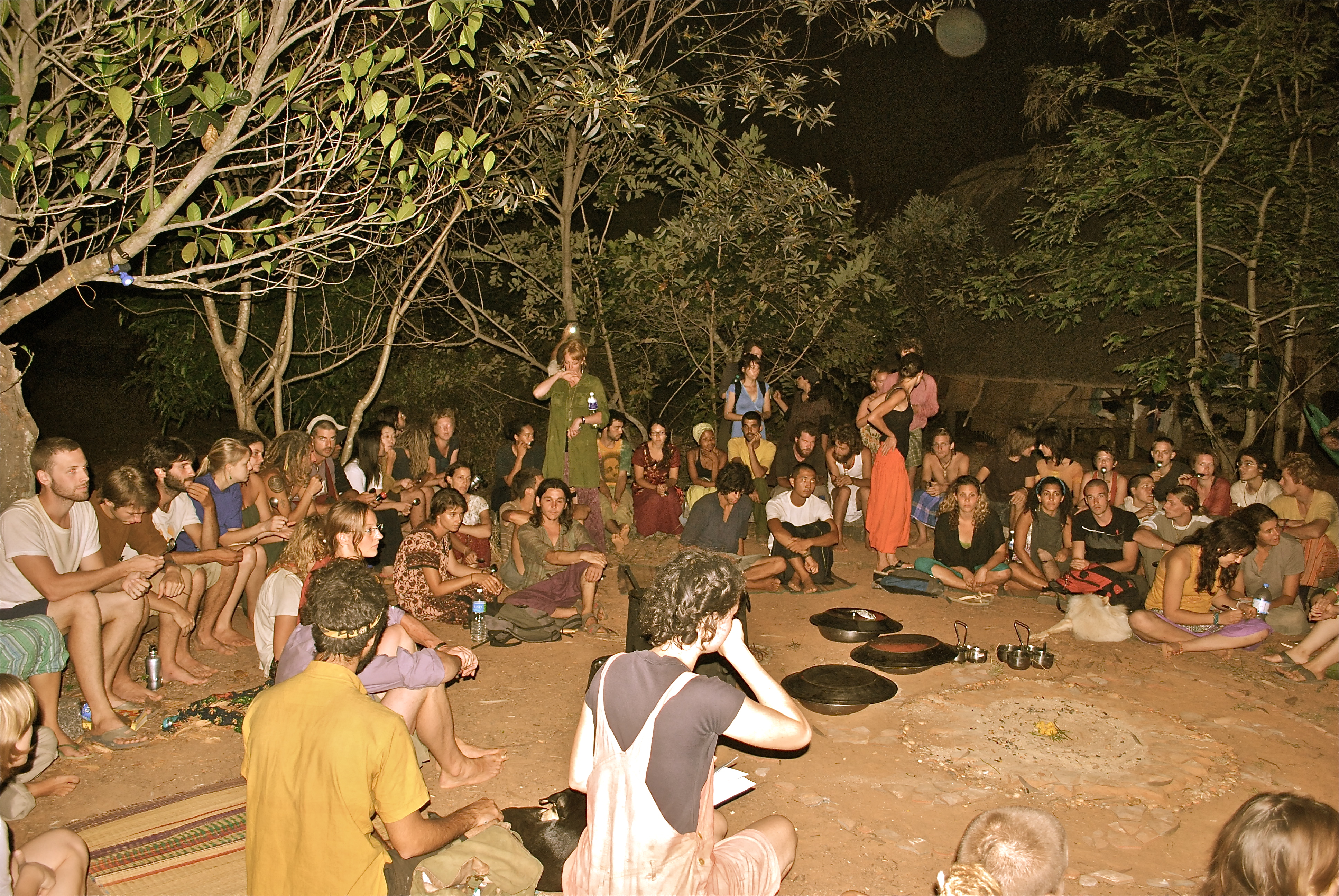
In my travels to Asia in 2009, I began in Auroville, India in southern province of Tamil Nadu. This region is a wet/dry monsoon region but a very brittle climate as its abundant rainfall is limited to only two short rainy seasons lasting 8-10 weeks in total. As climate change is expressed through varying hydrologicial cycles, these regions are facing even more sporadic and extreme rainfall events especially with overexploitation of local natural resources. In general the brittleness is leading to the land breaking better known as desertification. I saw plenty of this in the surrounding areas of Auroville but for sure not at Sadhana Forest, a project in the outer zones of the radiating city plan that calls for forestry. Indeed a forest was grown, a “forest that grows people”. It all hinges upon the work that the pioneers there did with swales formed into bunds (compacted swales) and also large infiltration pits at the bottom of the land where water was naturally being funneled. At first glance this would have looked like a pond construction but the bottom was uncompacted and the pebble laden soils didn’t hold water there. Instead these large earthworks infiltrated huge volumes of water.


These Earthworks transformed what co-founder of Sadhana Forest Aviram Rozim described as “a moonscape”, not a single blade of grass, with the only life seeming to be the cobra’s that would slither through on occasion. Once the water was put in the ground, a jungle of non-native acacia trees sprung out of the ground as if the water infiltration was a magic wand, an equal and opposite reaction. A reaction of positivity and regeneration in this case and the project was extremely inspirational as also the nearly 70,000 native trees that they planted of the local threatened ecosystem took more easily. The support of the “invasive” nitrogen fixers helped to modify the climate and acted as a buffer to the cyclonic storms in which that particular ecosystem entails. With the trees growing rapidly, with water harvesting measures in place and extending, the groundwater level had been drastically raised. And not just on their property but surrounding wells also. And with all of this growth of the land regenerating it seemed to permeate into the travelers who came to volunteer. This shows how the ethics of permaculture become an intertwining mandala and cause ripple effects beyond just countable numbers of trees planted.
Written by Doug Crouch
Header Art Bonita Edwards
