Written by Doug Crouch
Completion of a cycle can change Climates positively
Think back to biology class in high school or university. You may remember the hydrological cycle. Different books tell it different ways. Take a moment to define it for yourself. Draw a map. Jot it down on paper. Use arrows to show motion and energy flows. (Remember all those words that end in –tion?)
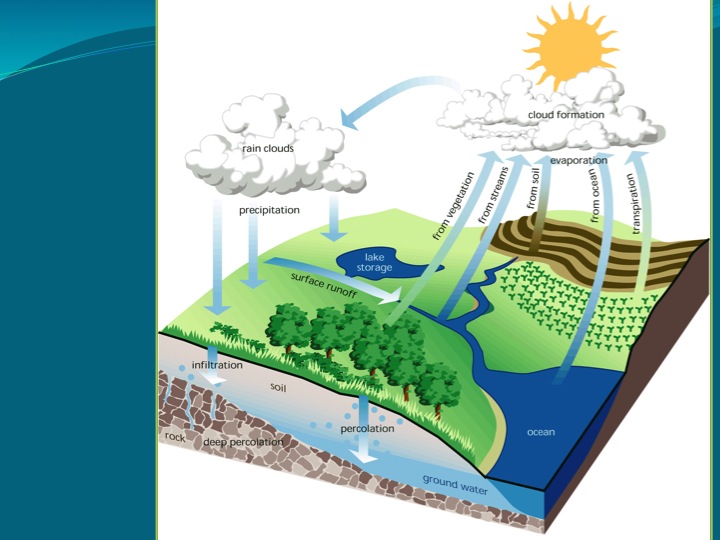
The map below shows a standard textbook perspective. Let me point out one missing factor that helps to differentiate the half and full hydrological cycles. This picture shows virtually the whole process but also reveals how disconnected we are from what, I believe, is a universal right and key to thrivability: the source or artesian springs. There are no springs emerging in the diagram unfortunately! Consequently, due to this factor and other factors absence, the half hydrological cycle emerges. This lack of completion is an outer representation of our dualistic, cartesian, rational way as our lack of foresight on the exploitation of natural resources has resulted in changing climates and the negative cascade. Patterns must be embraced, systems seen holistically- that is an interrelated set of parts that create.
Viktor Schauberger, referred to sometimes as the water wizard, adamantly touted the differences he was seeing in hydrological cycles, even in the early part of the last century. He saw man’s interference in nature breaking a vital cycle and was troubled deeply by it. Imagine interference in the vital cycles of your body. What would happen? Disease!

This is precisely what is occurring on Planet Earth – flood and drought disease. Over-consumption of energy and poisoned groundwater, famine and desertification, chlorine and fluoride, pumps and huge dams: Ouch! An intricate understanding of the cycle is vital so we can complete it. Lets cleanse this natural resource so it leaves a site with higher water quality than when it entered. All the while, our pattern aim entails slowing, spreading, and sinking water to revitalize groundwater supplies, energizing and recharging in its percolation to the caverns and aquifers of the earth as it flows over carbon and minerals.

The half hydrological cycle mainly involves precipitation and evaporation, but due to the lack of tree cover and/or perennial vegetation, evapo-transpiration simply does not happen. Soils are bare while concrete is exposed and abundant in city-scapes forcing rapid re-evaporation to occur. This tends to destabilize the atmosphere and frankly catapults onto society while stressing economic systems.
Usually, either torrential downpours flare or immediate cut-off of the rainy seasons ensue. Trees and other perennial vegetation buffer these effects. Without them, the environment suffers and so does its inhabitants, as precious natural and financial capital is erased. Without the buffer present, rivers flood, soils erode, coral suffers, and landscapes dehydrate. This again cascades into financial loss from property damage and societal drains in the form of famine or disease.

The problem exacerbates, unfortunately, with groundwater levels initially rapidly rising, then dropping, due to temperature mechanics which leaves behind salt laden soils. Especially in drylands, this is how deserts form. Desertification grows  exponentially as the ground is no longer fit for receiving water, thus reducing the landscape’s ability to remain resilient. If your body’s blood becomes sick, you get terminal diseases like leukemia.
Without buffers, the natural capital of landscape cannot perform its ecosystem services (i.e. rainfall infiltration rates fall from 100% absorption to 20% from mature prairie to corn or soy field). In human analogy, if you have heart disease, your heart will obviously not work optimally. So rainy seasons become intensified, shortened, and most importantly, the landscape is mostly unreceptive to the rainfall itself no matter the amount. Those drylands areas that receive 10 inches of rain annualy, the ground may only absorb two inches, further pushing desertification at an exponential rate. Moreover, the rain fall also evaporates more quickly because of lack of tree cover and lack of organic material in the soil, while runoff rates increase to a rate that rivers are unable to handle (the other 80% or eight inches in the examples above). With wetlands drained, beavers and other shapers of water systems largely extinguished, and soils eroded of their organic mater, there is widespread flooding, desertification and crop failure as ecosystem resilience has been exhausted.

The above graph shows this unreceptiveness in the context of one factor that Schauberger felt was extremely important – temperature. Having spent time at Lost Valley Educational Center in Dexter, Oregon (where I did my PDC in 2005 and taught in 2007, 2008), and receiving hot water from thermal dynamics moving hot water uphill, it is easy to see how temperature does easily influence movement. Furthermore, high pressure and low pressure systems are two other classic examples of temperature causing movement. Consequently, the above drawing shows how lack of tree cover creates a temperature regime that forces water to runoff. With the land being warmer than the rain, the earth turns to concrete in a sense, pores closed, runoff raging. This runoff picks up soils and intensifies through a watershed, decreasing water quality dramatically from point and non point source pollution.
The temperature change under deforestation also creates a sudden rise in the groundwater and then a deep dropping. This brings forth salty conditions and is a direct cause of desertification. With deserts expanding and the consequences of superstorms and 100-year floods happening far too often, it is easy to see why permaculturists advocate for measures to complete the hydrological cycle. Attitudinally it reinforces the “act local and think global” mentality that allows us to positively impact our environment instead of wallowing in a climate change debate and depression. We must complete local hydrological cycles to change the climate on a global scale. We all want our local creeks and streams and rivers to be cleaner- no?
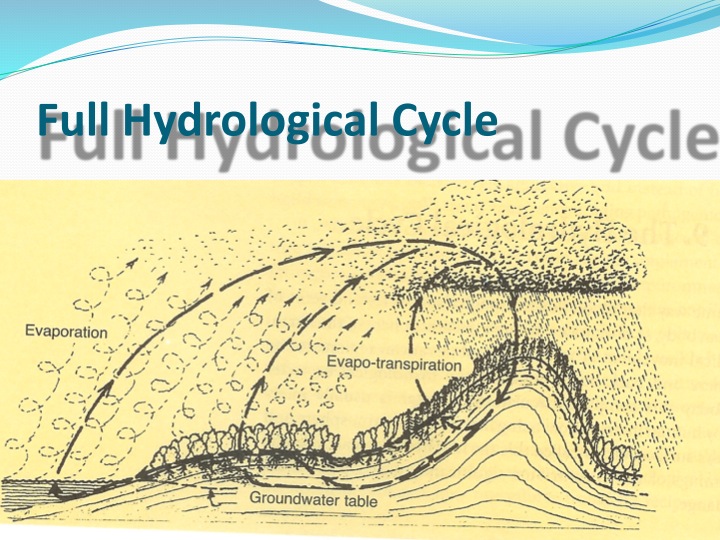
However, the full hydrological cycle shows much more balance. Schauberger said this was literally a female/male balance analogous to the yin/yang symbol from eastern philosophy. The theory being that the ocean and open land creates evaporation, a male-based energy denoted by spirals in one direction in the drawing above as it is driven by the penetrating sun.
The spirals in the other direction, the female-driven energy, is evapotranspiration. The roots of trees are tapping into “mother earth” in the form of groundwater and stored water in the organic matter at the surface of the earth. These different isotopes in evaporation and evapotranspiration have been studied and prove this scientifically. Fortunately, this balance buffers extremes and dramatically increases the infiltration rate. Groundwater stays at a healthy level, nourishing forests, and organic matter builds so that it can hold and store water. The cycle is perpetuated. Rivers are less flashy and the groundwater release is more constant in rivers and streams, allowing them to run all year round in some instances. Streams run clearer, allowing fish habitat to build, and the natural process of meandering to further increase water quality and habitat creation. Aquatic ecology builds as diversity and complexity rebound in an exponential factor, the way of the Fibonacci sequence.
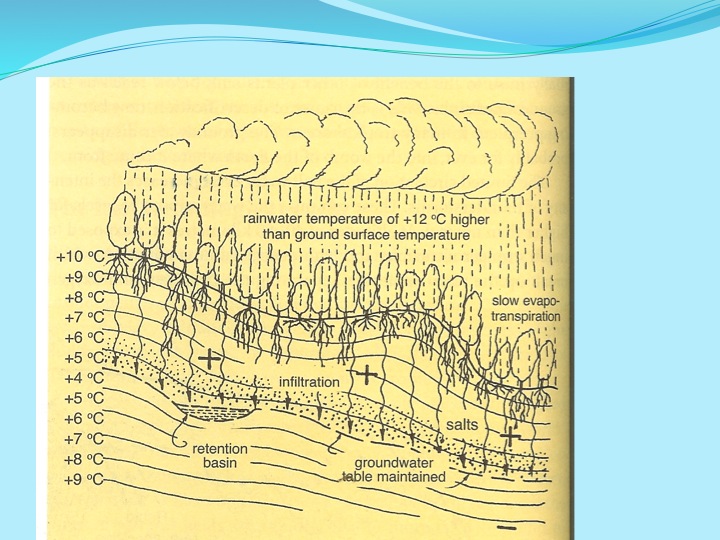
Temperature regimes are conducive for infiltration as the soil is cool and much more open when tree cover exists. Of course, temperature is just one factor. The leaves and layers of the forest help to slow down and retain the water much more.

A greater diversity of soil microorganisms is supported in perennial vegetation and forests, the catalyst for all of this. A healthy soil food web builds organic matter, which builds more layers of vegetation, which helps to infiltrate more water, which helps to build a healthy soil food web, which . . . on and on and on. The next time you look at a forest you should really see a lake for all of the water that is stored there. When you see a green field of corn you should see a desert.
In conclusion, when animals are over- or under-grazed, when soils are tilled too often and left open and bare, when chemicals are abused, and when forests are cleared, the hydrological cycle suffers. As permaculture designers, this cycle of completion will emerge as one of the most pivotal accomplishments in our quest for transformation of our society and environment. Swales and rain gardens that capture our roof and street runoff, basins for greywater recycling, keyline plowing and rotational grazing on the broadacre, tree crop prominence and reforestation, and advanced soil biology regeneration are some of the strategies and techniques we will use.

To complete the cycle is to regenerate. To break the cycle of violence on water is paramount.
“Actually, the mysteries of water are similar to those of the blood in the human body. In Nature, normal functions are fulfilled by water just as blood provides many important functions for mankind” – Viktor Schauberger.

References:
Bartholomew, A. (2003), “Hidden Nature: The Hidden Insights of Viktor Schauberger.” Edinburgh, Scotland. Floris Books.
Mollison, B. & Slay, R.M. (1991). Introduction to Permaculture. Tasmania: Tagari.
Written by Doug Crouch
Header Art by Anita Tirone
